
Security camera technology has advanced dramatically in the past five years. What once required a dedicated security room full of recording equipment can now be managed from a smartphone app. But greater choice also means greater confusion. Walk into any electronics market in Deira and you will be confronted with hundreds of cameras ranging from AED 50 to AED 5,000 each — and the cheapest option is rarely the right one. This guide explains what actually matters when specifying a CCTV system for a Dubai home or business.
Step 1: Define What You Need to Protect
Before comparing cameras, map out the specific areas you want to monitor. For a villa, this typically means: the front gate and driveway, the main entrance, all ground-floor windows and doors, and the rear garden. For a retail business: the front entrance, the point of sale, stockroom entry, and the car park. Different zones require different camera types — a wide-angle camera that works well on a driveway is the wrong choice for a narrow corridor.
Step 2: Choose the Right Resolution
Resolution determines how much detail your cameras capture. The standard today is 4MP (2.8K) for most applications, with 8MP (4K) recommended for wide open areas where you need to zoom in on distant details such as number plates. Avoid anything below 2MP (Full HD) — older 720p cameras produce footage that is too blurry to be useful as evidence. Higher resolution also means larger file sizes, which affects your storage requirements.
Step 3: Bullet, Dome, or PTZ?
The physical camera format matters as much as the resolution.
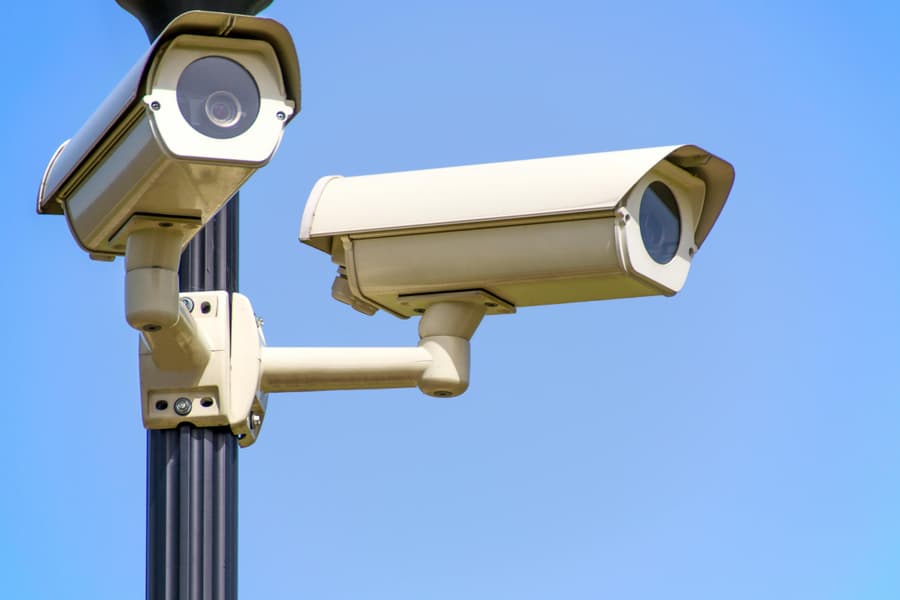
- Bullet cameras are the long cylindrical type, visible and weather-resistant. They act as a deterrent and are ideal for driveways, car parks, and building perimeters. Their fixed lens means you must aim them correctly during installation.
- Dome cameras are the compact, ceiling-mounted type common in retail shops, lobbies, and offices. The dark dome housing makes it hard for anyone to tell which direction the camera is pointing, which reduces tampering.
- PTZ (Pan-Tilt-Zoom) cameras can be remotely steered to follow movement. They are excellent for large open areas like car parks or warehouses but cost significantly more and require more complex installation.
Step 4: Indoor vs. Outdoor Ratings
All outdoor cameras must carry an IP66 or IP67 weatherproofing rating as a minimum. In Dubai, where summer heat regularly exceeds 45 °C and the occasional sandstorm fills the air with fine abrasive particles, an IP66 rating is the baseline — not a premium feature. Indoor cameras can use lighter enclosures, but if installed in a kitchen or bathroom, they also need moisture resistance. Check that any camera installed outdoors also carries an IK10 impact resistance rating if vandalism is a concern.
Step 5: Night Vision — Infrared vs. Colour Night Vision
Standard infrared (IR) cameras switch to black-and-white night mode when light levels drop, using invisible IR LEDs to illuminate the scene. Modern colour night vision cameras (marketed as 'full-colour' or 'Starlight') use larger image sensors and wide-aperture lenses to capture colour footage in very low light — without illuminating the scene with visible light. For high-risk areas where identifying clothing colours or vehicle colours is important, colour night vision is worth the additional cost.
Step 6: Storage — Local NVR/DVR vs. Cloud
Your footage has to be stored somewhere. The two main options are a Network Video Recorder (NVR) for IP cameras or a Digital Video Recorder (DVR) for older analogue cameras, both stored on-site. Alternatively, many modern camera systems offer cloud storage subscriptions. For most Dubai homes and small businesses, we recommend a local NVR with at least 2TB of storage, providing 30 days of continuous recording at 4MP. This eliminates monthly subscription costs and keeps footage accessible even during internet outages.
Step 7: Remote Viewing and Smart Features
Look for systems that offer a stable mobile app for remote viewing, push notifications for motion detection events, and the ability to share clips. Avoid cheap systems from unknown brands — their mobile apps are often discontinued within two years, leaving you unable to remotely access your system. Hikvision, Dahua, and Hanwha (Samsung Techwin) are the three brands we install most frequently at Al Bahr Al Hadi, with robust long-term app support and local technical backing in the UAE.
Dubai Legal Requirements for CCTV
The UAE has clear rules governing CCTV use. Cameras may not be directed into a neighbour's property, public streets without a permit, or areas where there is a reasonable expectation of privacy such as bathrooms or changing rooms. Commercial properties in Dubai are required to install CCTV in certain areas under Dubai Police guidelines, and the footage must be retained for a minimum of 30 days. If your system is for a business, discuss compliance requirements with your installer before specifying camera positions.
💡 Pro Tip
Installation tip: Place cameras high enough to be out of easy reach (minimum 3 metres) but at an angle that still captures facial features clearly. A camera pointed straight down from 5 metres will capture the tops of heads — not useful for identification.
Why Professional Installation Matters
A poorly installed CCTV system creates a false sense of security. Blind spots, incorrect camera angles, inadequate cable management, and insufficient storage settings can all render a system useless when you actually need it. Al Bahr Al Hadi provides a full site survey before every installation, a written camera placement plan, professional cabling concealed within conduit, and a handover session so you know exactly how to use your system.
Conclusion
Choosing the right CCTV system is about matching camera specifications to your specific environment, understanding storage and legal requirements, and ensuring professional installation. If you are unsure where to start, our security specialists at Al Bahr Al Hadi offer free on-site consultations across all Dubai communities. We design, supply, and install systems for villas, apartments, retail outlets, offices, and warehouses.