Electrical fires account for a significant proportion of residential fires in the UAE every year, according to Dubai Civil Defence reports. The alarming reality is that most of these fires are preventable — they result from outdated wiring, overloaded circuits, or DIY repairs that bypass safety standards. Because wiring is hidden inside walls and ceilings, the problems are often invisible until something goes seriously wrong.
How Old is 'Too Old' for Wiring?
Modern electrical standards in Dubai follow DEWA regulations and international IEC codes. Properties built before the mid-2000s may use aluminium wiring or older insulation that has become brittle with age. Even newer buildings can develop wiring problems through poor installation, overloading, or rodent damage inside walls. As a rule of thumb, any property over fifteen years old that has not had a wiring inspection should be assessed by a licensed electrician.
Warning Sign 1: Frequent Circuit Breaker Trips
A circuit breaker that trips once or twice a year when you run too many appliances simultaneously is doing its job. A breaker that trips weekly — or one that you have learned to live with by keeping it in the 'off' position and using the other circuits — is a serious red flag. It means the circuit is regularly being asked to carry more current than it was designed for, and the wiring is heating up every time this happens.
Warning Sign 2: Flickering or Dimming Lights
Occasional dimming when a large appliance like a washing machine starts up is normal. But persistent flickering, lights that dim randomly, or lights in one room that flicker when an appliance in another room switches on can indicate a loose connection, overloaded circuit, or a failing main service panel. These loose connections generate heat and can arc — producing sparks inside your walls.
Warning Sign 3: Discoloured or Burnt Outlets and Switches
Brown or black scorch marks around a socket or switch plate indicate that arcing or sparking has already occurred behind the outlet. This is an immediate fire risk. Switch off the circuit at the breaker and do not use that outlet until a licensed electrician has inspected and replaced the wiring behind it.
Warning Sign 4: A Persistent Burning Smell
A burning plastic smell — especially one that is stronger near your distribution board, in one particular room, or around a specific socket — is one of the most urgent warning signs. Do not ignore it or assume it will go away. Switch off the main breaker and call an electrician immediately. Arcing inside a wall cavity can smoulder for hours before igniting surrounding materials.
Warning Sign 5: Buzzing or Crackling Sounds
Electricity should be silent. Buzzing from a light fitting could be a loose ballast or a flickering bulb. Buzzing or crackling from an outlet, switch, or distribution board almost always indicates arcing, a loose connection, or a faulty component. In all cases, the sound requires investigation by a professional — never attempt to open a distribution board yourself.
Warning Sign 6: You Still Have a Fuse Box Instead of an MCB Panel
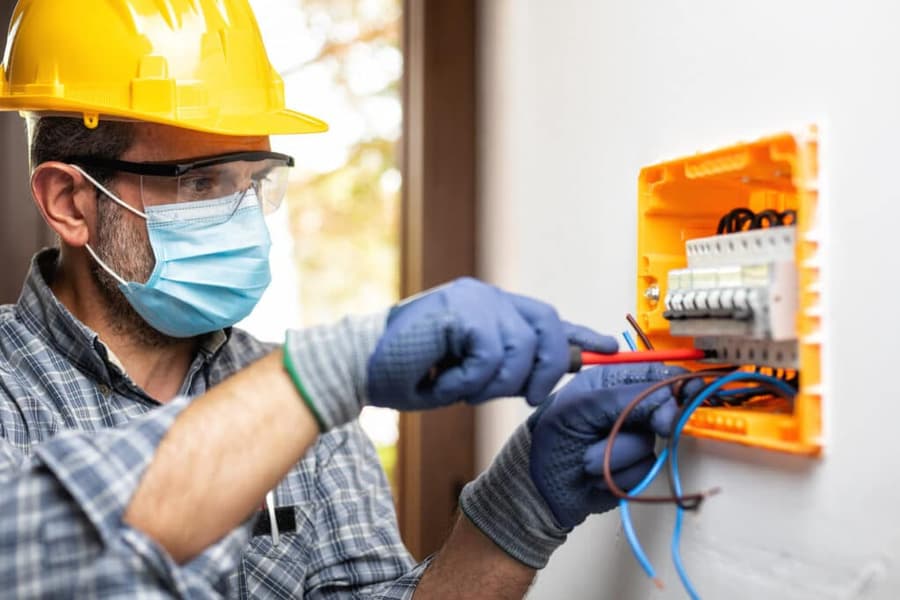
Older properties — particularly villas built in the 1980s and 1990s — may still use rewireable fuse boxes rather than modern Miniature Circuit Breaker (MCB) panels with residual current devices (RCDs). Fuse boxes offer no protection against electric shock and react far more slowly to overloads than MCBs. DEWA regulations now require MCB panels with RCDs in all residential properties. If you have a fuse box, upgrading it is not optional — it is a safety and compliance requirement.
Warning Sign 7: Not Enough Sockets for Modern Living
This sounds minor, but it matters. If your household or office relies heavily on extension leads and multi-way adapters, it means the original wiring was designed for far fewer appliances than you are running today. Overloaded extension leads are a major fire risk, and the sustained additional load on the circuits can degrade wiring insulation over time. The correct solution is to have additional circuits and sockets professionally installed.
What Does a Rewiring Project Involve?
A full rewire involves replacing all circuit cables from the distribution board to every socket, switch, and light fitting in the property. Our licensed electricians at Al Bahr Al Hadi will survey the property first, provide a detailed quotation, obtain any necessary DEWA approvals, and carry out the work with minimal disruption. We also issue a completion certificate that is required for DEWA inspection.
- Full property electrical survey and fault diagnosis
- Complete rewiring from distribution board to all outlets
- Upgrade to modern MCB panel with RCD protection
- Installation of additional sockets and circuits as required
- DEWA compliance certification upon completion
💡 Pro Tip
Safety reminder: Never attempt electrical repairs without isolating the circuit at the breaker first. Even low-voltage circuits in Dubai can deliver a fatal shock. Always use a licensed electrician for any work beyond changing a light bulb.
Conclusion
Electrical problems rarely announce themselves dramatically — they build slowly and quietly until a critical failure occurs. If you recognise any of the warning signs above, book a no-obligation electrical inspection with Al Bahr Al Hadi. Our DEWA-approved electricians serve all areas of Dubai, with same-day emergency response available around the clock.